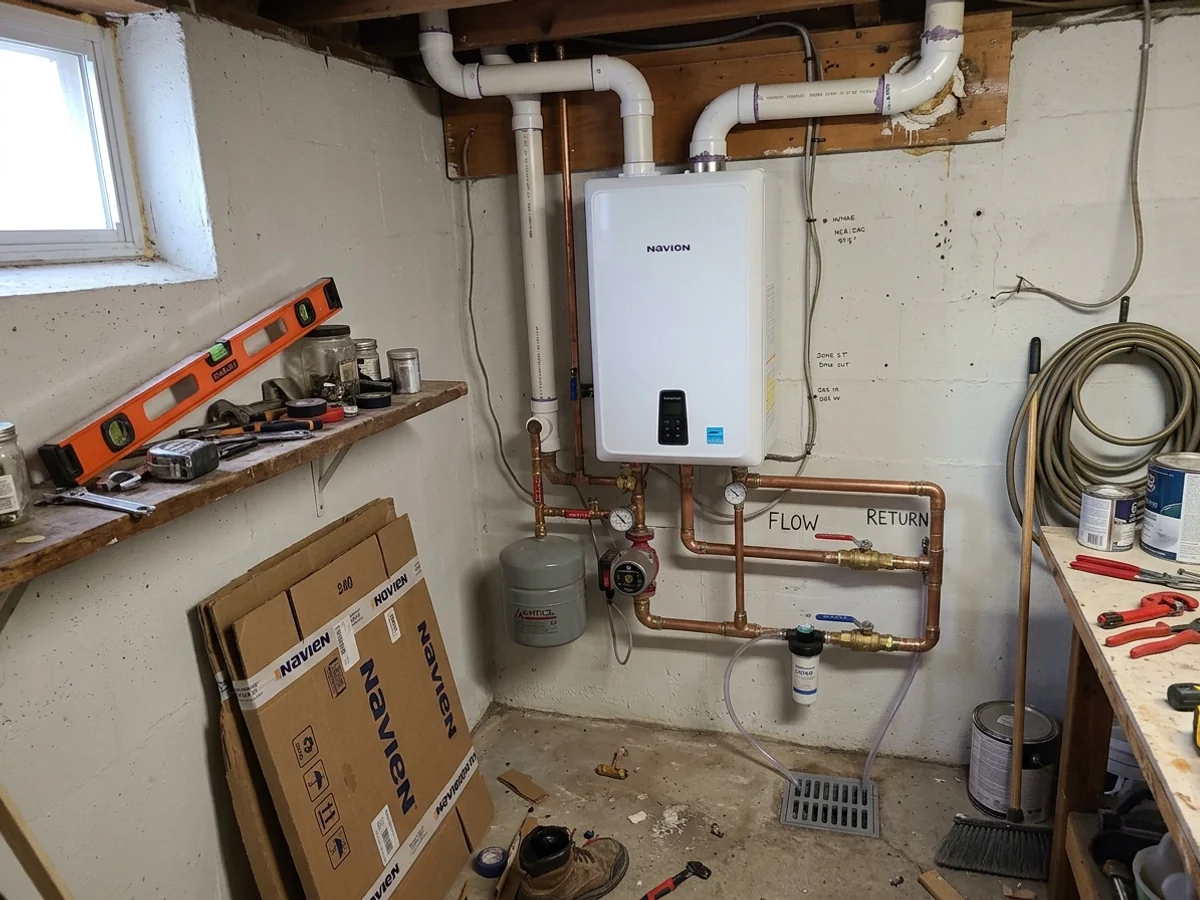
What Is High-Efficiency Condensing Boiler Installation in Toronto?
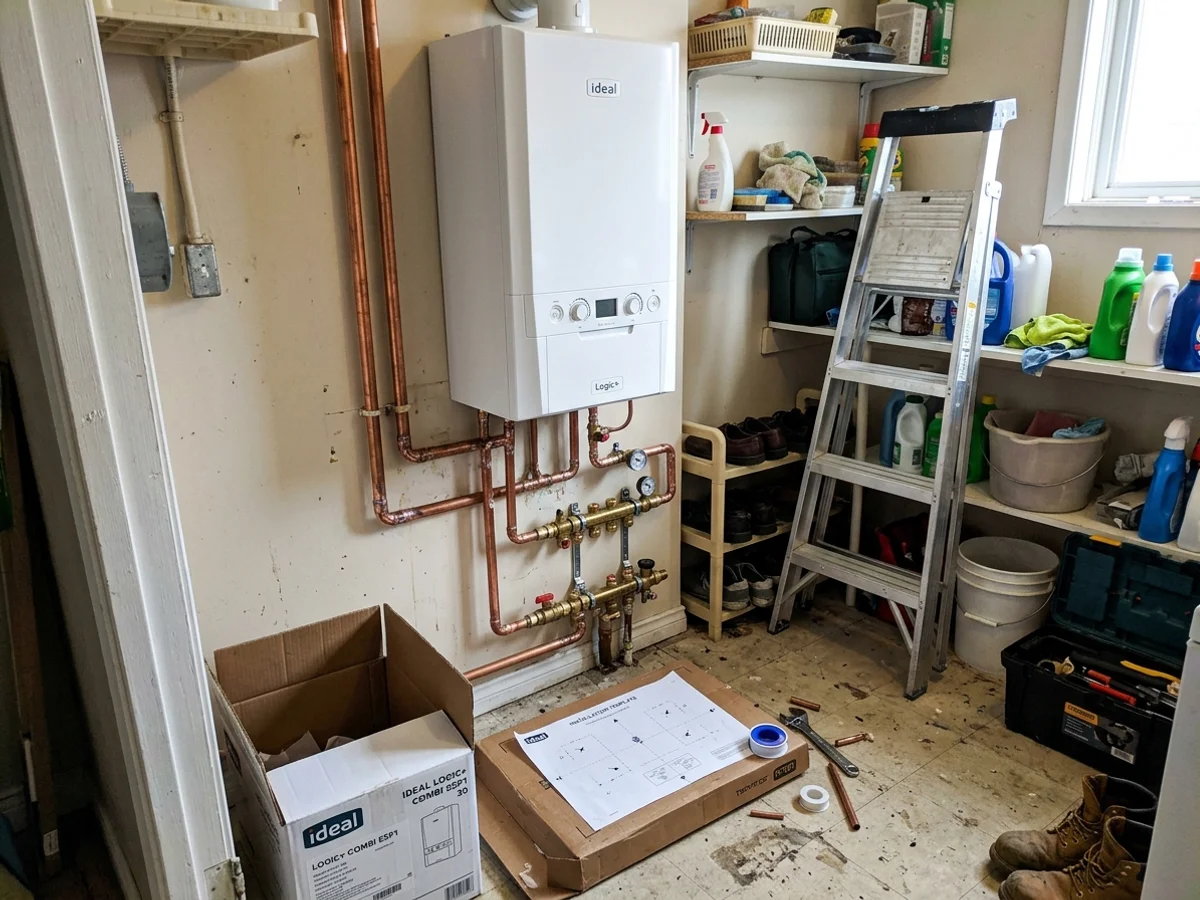
High-efficiency condensing boiler installation in Toronto means replacing a mid-efficiency gas boiler with a 95%+ AFUE condensing unit for $6,500 to $12,000 CAD, and it is the single highest-value heating upgrade available to a GTA homeowner right now. The condensing part is literal. Exhaust gas from a conventional boiler leaves the flue at around 350F carrying a large amount of energy in the form of water vapour. A condensing boiler routes that exhaust through a 316L stainless steel heat exchanger cooled by the system return water, drops it below its dew point, and recovers the latent heat as the vapour condenses. That recovered energy is what turns 80 percent efficiency into 95 percent or better.
For a Toronto house burning $2,400 CAD of natural gas a year on heating, the difference between 80 and 95 percent AFUE is roughly $380 to $840 CAD annually depending on how the system is controlled. Add the Enbridge Home Efficiency Rebate Plus at up to $6,500 CAD and the Canada Greener Homes Grant at up to $5,000 CAD, and the payback window for most homes lands between 6 and 10 years. Every technician on the install holds a valid TSSA G1 or G2 gas certification, and the work is completed to Ontario B149 fuel code, CSA B51, and Ontario Building Code Part 6 and Part 7. The same standard applies across all our boiler installation work in Toronto and the wider GTA.
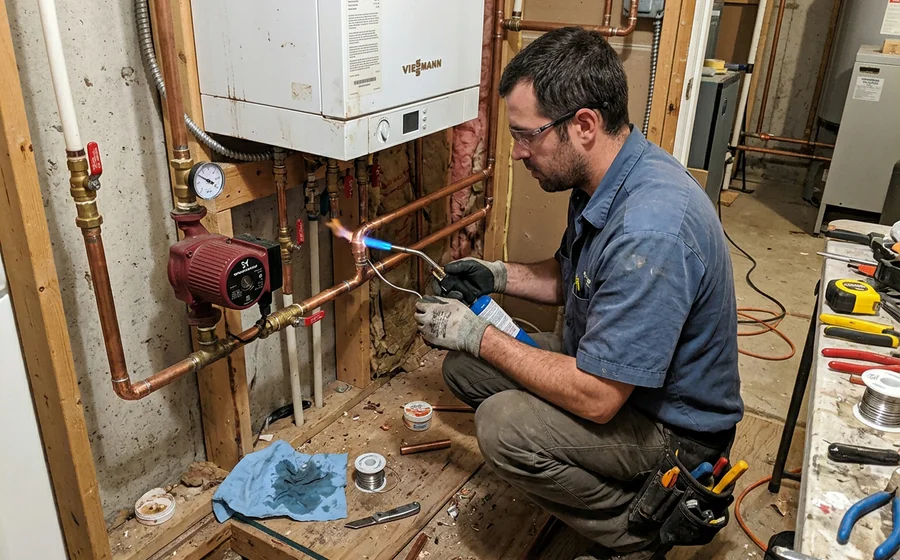
The 3 Ontario Rebates on a 95% AFUE Install
Rebate coordination is not paperwork you should have to chase yourself. Three programs stack on a qualifying high-efficiency installation, and we file all three.
- Enbridge Home Efficiency Rebate Plus, up to $6,500 CAD. This is the largest single offset available. It requires a pre-retrofit energy assessment, a qualifying 95%+ AFUE unit, and at least one additional envelope measure such as attic or basement insulation. The boiler alone will not unlock the full amount, which is why we flag the insulation requirement during the site assessment rather than after the install.
- Canada Greener Homes Grant, up to $5,000 CAD. The federal grant covers eligible high-efficiency heating equipment and also requires pre and post energy evaluations. It stacks with the Enbridge program, which is how the combined offset reaches $11,500 CAD.
- Canada Greener Homes Loan, up to $40,000 CAD at 0% interest. Not a rebate but worth naming, because it turns a $9,500 CAD installation into a monthly payment lower than the gas savings on many homes. Repayment runs over ten years with no interest.
The sequencing matters. Both rebate programs require the energy assessment to happen before the old boiler comes out. Booking the install first and asking about rebates afterwards is the most common way Toronto homeowners lose the offset, and it is not recoverable once the equipment is gone.
How Much Does a High-Efficiency Boiler Cost in Toronto?
The published band is $6,500 to $12,000 CAD. Where you land inside it comes down to five factors.
| Factor | Adds to the cost | Typical CAD impact |
|---|---|---|
| Existing PVC venting can be reused | No | Baseline |
| New side-wall or concentric vent run required | Yes | $900 - $1,800 CAD |
| Chimney flue de-commissioning and liner resize | Yes | $700 - $1,500 CAD |
| Near-boiler piping rebuilt (primary secondary loop) | Yes | $1,200 - $2,500 CAD |
| Mixing valve and return-water protection for radiators | Yes | $800 - $1,600 CAD |
Two houses on the same street can sit $4,000 CAD apart purely on venting and near-boiler piping. That is why the quote follows a site assessment rather than a phone call, and why every line appears in Canadian dollars before anything is ordered. The diagnostic fee of $99 to $249 CAD is waived when you authorise the installation on the same visit.
Types of High-Efficiency Boiler Installation We Handle
Straight swap onto existing hydronic distribution. The home already runs a condensing or sealed unit with PVC venting and a reasonable near-boiler manifold. The new boiler is sized by Manual J, dropped in, commissioned, and the controls updated. $6,500 to $8,500 CAD, one working day.
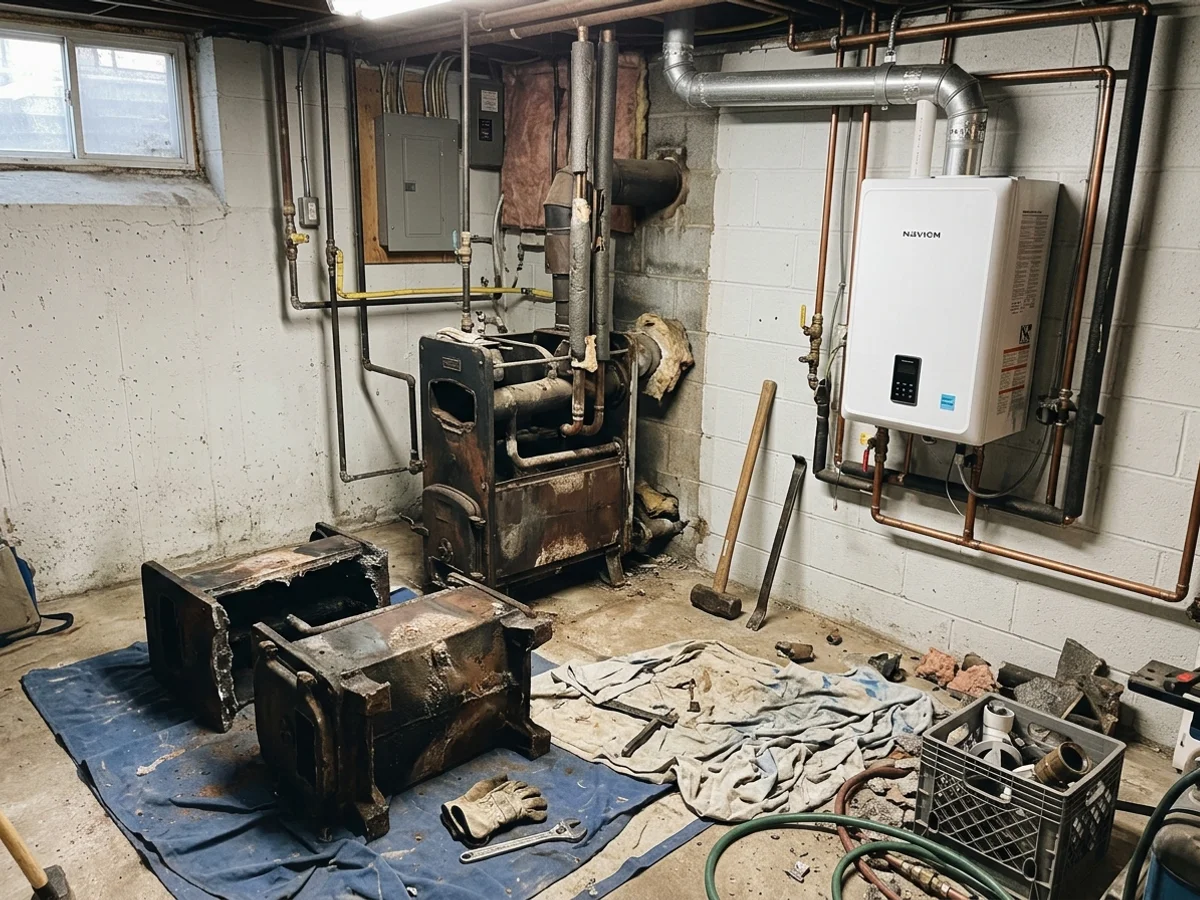
Standard retrofit with new venting. The outgoing boiler was a mid-efficiency unit venting into a chimney. New PVC concentric or side-wall direct venting is routed, the masonry flue is de-commissioned for the boiler, and an outdoor reset control is added. $8,500 to $10,500 CAD.
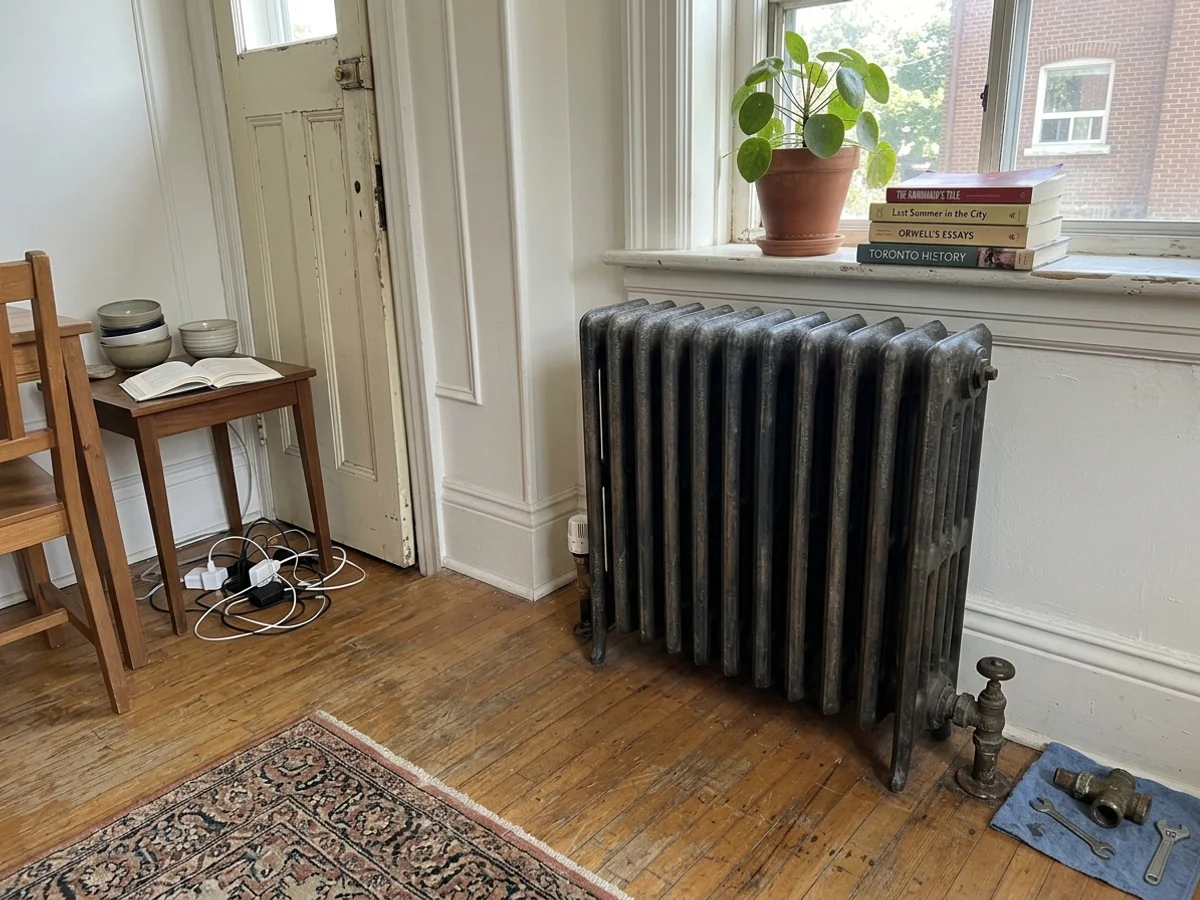
Cast iron radiator conversion. Common in Riverdale, Cabbagetown, The Annex, and The Kingsway. The radiators stay, the near-boiler piping is rebuilt as a primary secondary loop, and a mixing valve plus return-water temperature protection keeps the return cool enough for the boiler to condense. $10,500 to $12,000 CAD, and up to $14,500 CAD where the radiator count and piping complexity are high.
Commercial and multi-unit. Cascading multiple condensing boilers on a common venting header for retail plazas and mid-rise mechanical rooms. See Commercial Boiler Installation Toronto for the CSA B51 and ASME Section IV details.
When Do You Need a High-Efficiency Retrofit?
You are a candidate right now if any of these describe your system. A boiler over 20 years old with an 80 percent or lower AFUE rating. Gas bills climbing year over year with no change in thermostat habits or occupancy. Visible rust staining at the base of the unit or condensation inside a flue that should be dry. Pressure that needs topping up every few weeks. A plan to stay in the house for at least seven more years, which comfortably clears the payback window once rebates are applied.
You are not a candidate, and we will say so, if the existing unit is a well-maintained condensing boiler under ten years old, or if the property is being sold within twelve months and the buyer will not pay for the upgrade. In both cases a boiler maintenance visit at $199 to $349 CAD is the better spend.
What Actually Stops Toronto Homeowners From Upgrading
The objection we hear most is that the quote looks large next to a repair. It is worth breaking down what the number covers. A $9,000 CAD condensing installation is not a boiler with a bow on it. It is the unit itself, the 316L stainless heat exchanger, a new condensate line with an acid neutraliser cartridge, PVC flue rework, a rebuilt near-boiler manifold with isolation valves, an expansion tank and pressure relief valve, zone controls, an outdoor reset sensor, the TSSA permit, the inspection, disposal and scrap recycling of the old unit, and the rebate filing. Priced separately those items do not come in cheaper.
The second objection is that nobody can verify the technician is licensed. Ontario requires TSSA G1 or G2 certification for gas boiler work, plus CSA B51 for pressure vessels above the residential threshold. The certificate number of the technician who did the work appears on your invoice, and the TSSA permit number appears on the completed job. You should ask for both from any contractor, not only from us.
The third is efficiency scepticism. A rated 95 percent boiler installed without outdoor reset, feeding radiators at a fixed 180F, will never condense and will deliver something closer to 87 percent in practice. The rating is a laboratory number. The installed result depends entirely on control strategy and return-water temperature, which is the part of the job that separates a competent hydronic installer from someone who swaps boxes.
How Our Toronto High-Efficiency Installation Process Works
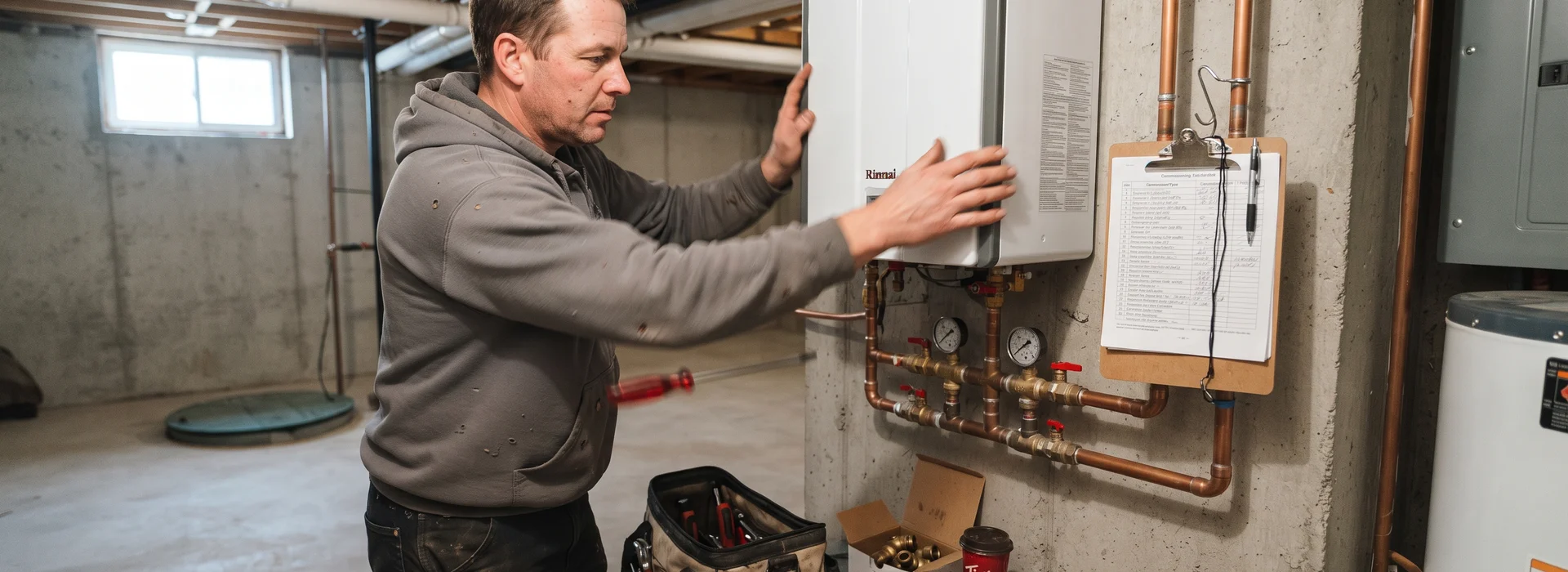
The six-step framework runs the same way on every high-efficiency job. Site assessment covering postal code, home age, distribution type, existing AFUE, and heating load in BTU per square foot, booked same-day or next morning. Manual J heat load and equipment sizing, written, with the boiler matched to the calculated load rather than the old nameplate. Written CAD quote with three options, each showing parts, labour, permits, disposal, and the rebate offset. TSSA permit pulled and installation scheduled with Ontario Building Code Part 6 compliance verified. Installation, commissioning, and combustion analysis with a digital flue gas analyser and a CO monitor, near-boiler piping to ASHRAE 90.1, condensate neutralised, system purged and rebalanced. Post-installation verification with the TSSA inspection where required, warranty registration filed, Enbridge and Canada Greener Homes paperwork submitted, and the written workmanship warranty issued.
If the new boiler will feed original radiators, read Hydronic Heating and Radiator Installation Toronto next, since the distribution side is where the real efficiency is won or lost. If the current unit has already failed and you are deciding between fixing and replacing, Boiler Replacement Toronto covers the end-of-life decision in detail.