24/7 Cold Snap Emergency Response(647) 254-9788
Toronto Boiler Installation

Hydronic Heating and Radiator Installation in Toronto: Cast Iron Radiators, Baseboard Convectors and PEX Manifold Distribution Across the GTA

Hydronic distribution design and radiator installation: cast iron column radiators, baseboard convectors, thermostatic radiator valves, and oxygen-barrier PEX manifolds, balanced and air-eliminated.

Published band $3,500 - $12,000 CAD distribution retrofit / add-on (CAD)
  • TSSA G1/G2 Licensed
  • 22 Years Experience
  • Same-Day GTA Dispatch
  • Written Workmanship Warranty
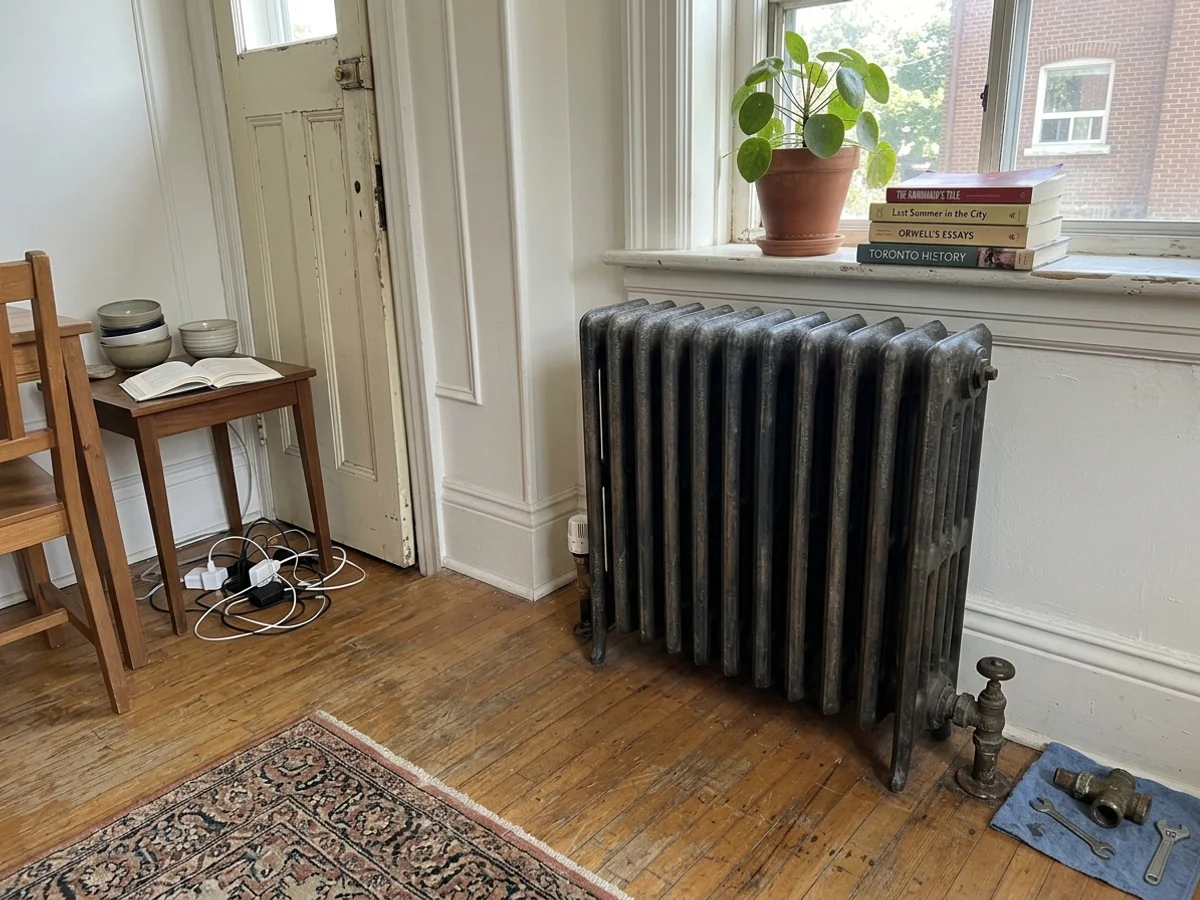
Restored cast iron column radiator with a thermostatic radiator valve in a pre-war Toronto living room
  • 5-Star Customer Satisfaction
  • Same-Day GTA Emergency Dispatch
  • 22 Years of Boiler Installation Experience
  • Written Workmanship Warranty

What Is Hydronic Heating and Radiator Installation in Toronto?

Hydronic heating and radiator installation in Toronto runs $3,500 to $12,000 CAD and covers everything on the distribution side of the boiler: cast iron column radiators, hydronic baseboard convectors, thermostatic radiator valves, oxygen-barrier PEX manifolds, balancing, and air elimination. Hydronic simply means heat carried by water rather than by air. In a city where a very large share of the housing stock predates forced air, it is the dominant heating method in Riverdale, Cabbagetown, The Annex, High Park, and The Kingsway.

The distribution side is where most systems succeed or fail, and it gets far less attention than the boiler. A 95%+ AFUE condensing boiler feeding an unbalanced, air-locked loop at a fixed 180F will heat the house badly and never reach its rated efficiency. A correctly balanced system with outdoor reset and return-water temperature protection will do both. That is why we treat distribution as its own discipline rather than as an afterthought on a boiler swap.
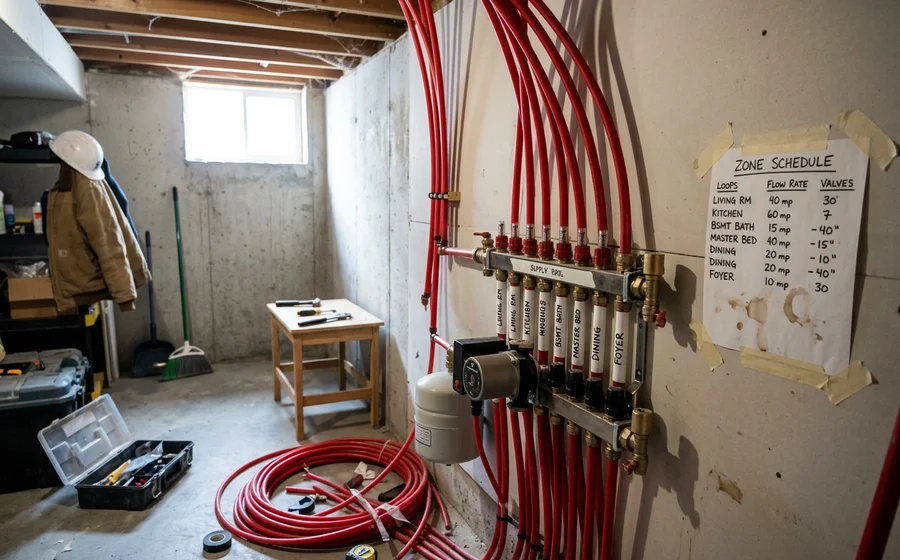
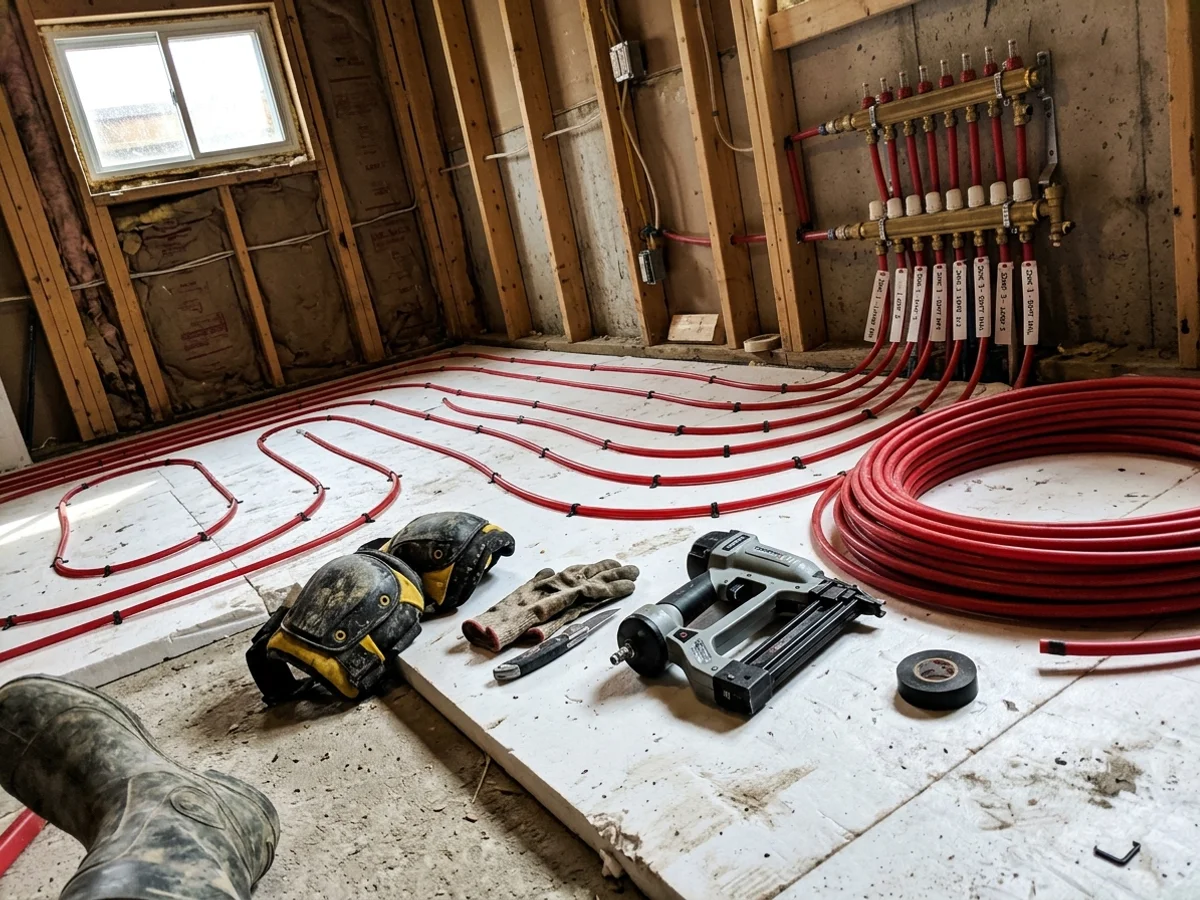
Oxygen-barrier PEX manifold with labelled loops and balancing valves mounted on a basement wall in a Toronto hydronic retrofit

6 Reasons Toronto Homeowners Choose Hydronic Over Forced Air

  1. Comfort. Water carries roughly 3,500 times more heat per unit volume than air. The result is a steady room temperature without the drafts and temperature swings of a blower cycling on and off.
  2. Silence. No blower, no duct rumble, no rush of air. On a quiet January night the only sound from a well-set-up hydronic system is nothing at all.
  3. Air quality. Nothing is being blown around the house. In a home built in 1925 with ninety years of dust settled inside the structure, that matters more than it does in new construction.
  4. Zoning. Splitting a house into independently controlled zones is straightforward and inexpensive with water. Zone valves and a manifold cost a fraction of what equivalent air zoning demands.
  5. Preservation. Installing ductwork in a pre-1950 Toronto home means opening plaster walls, losing ceiling height in the basement, and boxing in corners. Keeping the radiators avoids all of it.
  6. Efficiency pairing. A low-temperature hydronic system is what lets a condensing boiler condense. Forced air cannot deliver the same return-water temperatures.

How Much Does Hydronic and Radiator Work Cost in Toronto?

ScopeWhat it includesCAD band
Balance, bleed and air eliminationFull balance, air separator, TRVs on problem rooms, expansion tank check$3,500 - $5,500
Hydronic baseboard retrofitNew convector runs, PEX to manifold, zone valves, circulator sizing$5,500 - $9,500
Full distribution redesignGravity to pumped and zoned, radiators retained, mixing valve, near-boiler rebuild$9,500 - $12,000
Single radiator repair or replacementPer unit, within the published major repair band$450 - $1,200

The cheapest useful thing most Toronto homeowners can buy is a proper balance. Before replacing radiators or upsizing a boiler because “the back bedroom is always cold”, it is worth $3,500 to $5,500 CAD to find out whether the system was simply never balanced. A meaningful share of cold-room complaints resolve at that price.

Why Balancing Matters More Than Anything Else

Balancing means measuring the temperature drop, the delta T, between supply and return across every circuit under load and adjusting balancing valves until each one matches the design. A correctly balanced circuit typically shows a 20F drop. A circuit taking too much flow shows a small drop and starves its neighbours. A circuit taking too little shows a large drop and under-heats its room.

On a system that has been modified across eighty years, with radiators added, removed, and re-piped by different hands, the circuits nearest the boiler almost always take the easiest path. The far rooms get whatever is left. No amount of turning up the thermostat fixes that, because the problem is flow distribution rather than heat output.

Air compounds it. Water carries dissolved air, and as it heats that air comes out of solution and collects at the high points, blocking circulation entirely in the worst cases. Bleeding radiators helps temporarily. An air scoop or a Spirovent air separator on the supply header captures micro-bubbles continuously and vents them, which is the permanent answer.

Making Cast Iron Radiators Work With a Condensing Boiler

This is the technical heart of hydronic work in older Toronto homes. Cast iron column radiators were sized for 180F supply water. A condensing boiler only condenses, and therefore only reaches its rated 95%+ AFUE, when the water returning to it is below roughly 130F. Left alone, those two requirements contradict each other.

Three components bridge the gap. An outdoor reset curve that lowers supply temperature as outdoor temperature rises, so the system runs at 180F only on the coldest days and much cooler for most of the season. A mixing valve that blends return water into the supply to protect the boiler from thermal shock. And return-water temperature protection that holds the boiler above its minimum return temperature during start-up while still allowing it to condense at steady state.

Get those right and a 1920s radiator system delivers modern efficiency without touching a single radiator. Get them wrong and you have installed a premium condensing boiler that behaves like a mid-efficiency one.

What About Oxygen-Barrier PEX?

PEX tubing is slightly permeable to oxygen. In a system containing cast iron radiators, steel boiler sections, and cast iron circulator bodies, that oxygen corrodes metal from the inside and produces the black magnetite sludge found in neglected systems. Oxygen-barrier PEX carries an EVOH layer that blocks it.

We use PEX-a manufactured by the Engel method specifically, because its thermal memory allows tight bends and recovery from kinks with a heat gun rather than a coupling. Using non-barrier PEX on a ferrous hydronic system is a mistake that does not show up on install day. It shows up as a seized circulator five years later.

What Actually Stops Toronto Homeowners From Fixing Their Distribution

“We just need a bigger boiler” is the most common misdiagnosis. A cold back bedroom is very often a balancing or air problem on the distribution side, not a capacity problem at the boiler. Upsizing the boiler changes nothing about an unbalanced loop, and it is why a $3,500 to $5,500 CAD balance is worth ruling out before spending several thousand more on equipment that was never the issue.

“The radiators are old, should we not just replace them with something modern” is the second. Cast iron column radiators give quiet, even heat and were built to outlast several boilers. Replacing them means opening plaster in a house where that plaster is original. The better answer, in most cases, is designing the boiler and controls around the radiators you already have.

“I do not know if PEX matters as long as it carries water” is the third, and it is the one homeowners most often get wrong on a DIY or budget renovation. Standard PEX is slightly permeable to oxygen, and in a system with cast iron radiators and steel boiler sections, that oxygen corrodes metal from the inside and shows up as a seized circulator years later rather than as an obvious fault on install day. We use oxygen-barrier PEX-a specifically to avoid paying for that mistake twice.

How Our Hydronic Installation Process Works

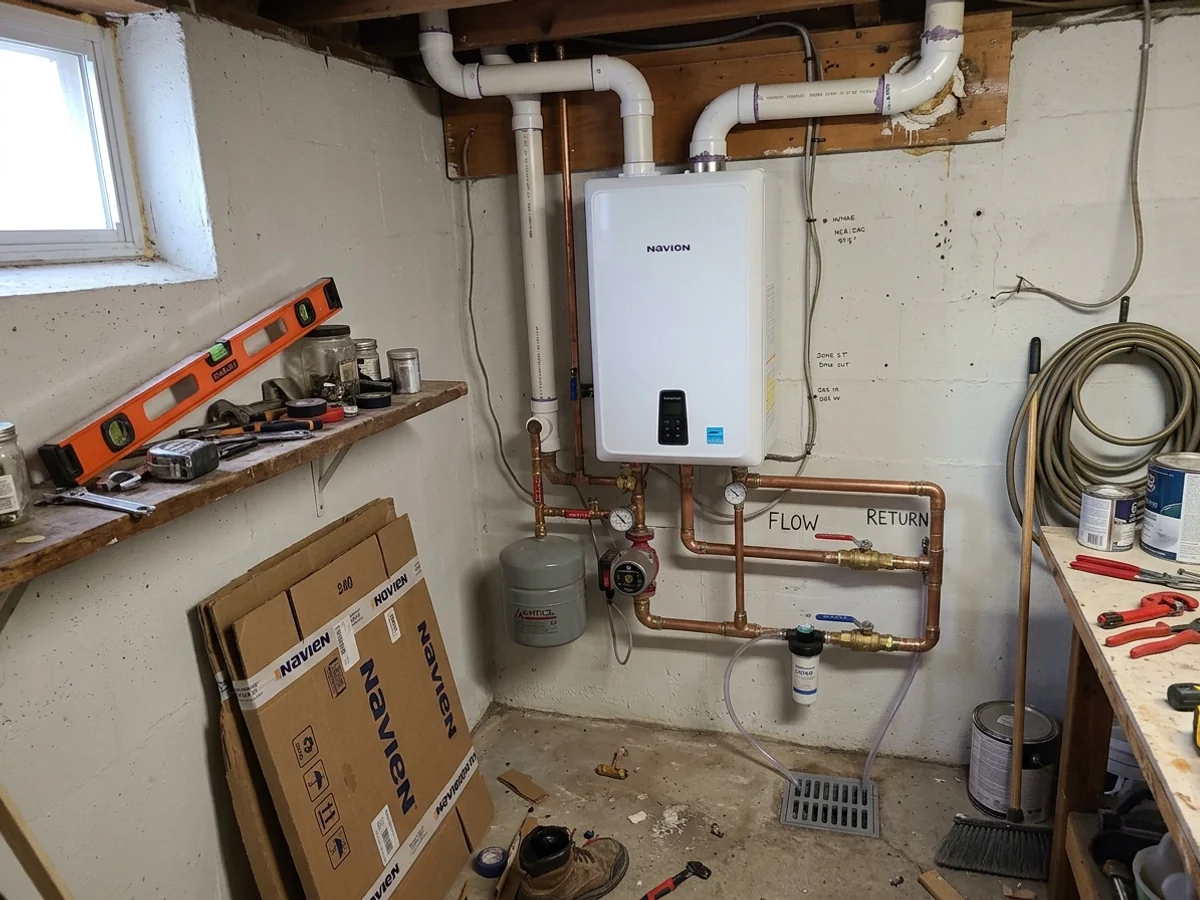
Distribution survey recording emitter count, pipe sizing, loop layout, and current supply and return temperatures room by room. Manual J heat load per room so each emitter is matched to the space it serves. Written CAD quote covering balance, baseboard retrofit, and full redesign options with emitters, piping, valves, and labour itemised. Scheduling staged so heat is never off for more than a working day, with a permit pulled where the gas or boiler side is affected. Installation and balancing with emitters fitted, the PEX manifold set, an air separator installed, loops purged, and delta T balanced across every circuit. Commissioning with the outdoor reset curve set, TRVs commissioned, room temperatures verified, and the written workmanship warranty issued.

If the floor is coming up anyway, compare In-Floor Radiant Heating Toronto before committing to baseboard. If the boiler is also at end of life, Boiler Replacement Toronto covers the equipment side and it is nearly always cheaper to do both at once. Our boiler installation and hydronic heating services in Toronto publish a CAD band for every scope.
Transparent CAD Pricing

How Much Does Hydronic & Radiators Cost in Toronto?

Published on the page, never gated. Every quote itemises parts, labour, TSSA permits, and disposal in Canadian dollars before any work starts.

Balance, Bleed and Air Elimination

$3,500 - $5,500 CAD

  • Full system balance across every emitter
  • Air scoop or Spirovent air separator fitted
  • Thermostatic radiator valves on problem rooms
  • Expansion tank pre-charge and PRV verification
Get This Quoted
Most Requested

Hydronic Baseboard Retrofit

$5,500 - $9,500 CAD

  • New hydronic baseboard convector runs
  • Oxygen-barrier PEX-a distribution to a manifold
  • Zone valves and circulator sizing
  • Continuous loop balancing and purge
Get This Quoted

Full Distribution Redesign

$9,500 - $12,000 CAD

  • Gravity hot water converted to pumped and zoned
  • Cast iron column radiators retained and rebalanced
  • Mixing valve and return-water temperature protection
  • Primary secondary near-boiler piping rebuilt
Get This Quoted

Hydronic distribution work is priced by emitter count, loop length, and whether the near-boiler piping needs rebuilding. Radiator repair or replacement is $450 to $1,200 CAD per unit within the published major repair band.

Why Choose Us

Why Choose Us for Hydronic & Radiators

22 Years of Boiler Installation Experience

Two decades of hydronic distribution work on pre-war Toronto radiators and modern GTA manifold systems.

Your Radiators Are Worth Keeping

Cast iron column radiators give quiet, even heat. Replacing them with ductwork means opening plaster. We design around them instead.

Balanced, Not Just Installed

Delta T is measured and balanced across every circuit. An unbalanced loop is the reason one room roasts while another stays cold.

Return-Water Protection as Standard

High-temperature radiators plus a condensing boiler need a mixing valve and return-water protection, or the boiler never condenses.

Oxygen-Barrier PEX Only

Non-barrier PEX lets oxygen into a ferrous system and corrodes circulators and cast iron from the inside. We use PEX-a with a barrier.

Published CAD Pricing

$3,500 to $12,000 CAD published on the page, with radiator repair or replacement at $450 to $1,200 CAD per unit.

The Framework

How Our Hydronic & Radiators Process Works

  1. 1

    Distribution survey

    Emitter count, pipe sizing, loop layout, and current supply and return temperatures recorded room by room.

  2. 2

    Heat load per room

    Manual J by room so each emitter is matched to the space it serves rather than to whatever was there before.

  3. 3

    Written CAD quote

    Balance, baseboard retrofit, and full redesign options priced in Canadian dollars with emitters, piping, valves, and labour itemised.

  4. 4

    Scheduling and staging

    Work staged so heat is never off for more than a working day. Permit pulled where the gas or boiler side is affected.

  5. 5

    Installation and balancing

    Emitters fitted, PEX manifold set, air separator installed, loops purged, and delta T balanced across every circuit.

  6. 6

    Commissioning and handover

    Outdoor reset curve set, TRVs commissioned, room temperatures verified, and the written workmanship warranty issued.

Want a written CAD quote for hydronic & radiators?

Published pricing bands, TSSA-licensed technicians, and the diagnostic waived on same-visit authorisation.

Our Work

Hydronic & Radiators Work Across Toronto and the GTA

Click any image to enlarge.

Customer Feedback

What Customers Say About Our Hydronic & Radiators Work

Two rooms never got warm and two were unbearable. They balanced the whole loop, fitted TRVs where they were needed, and added an air separator. $4,600 CAD and the house finally feels even.

Imogen T.

High Park

5-Star Customer Satisfaction

We finished the basement and needed heat down there. Baseboard run off a new PEX manifold, sized properly, zoned separately. $7,900 CAD.

Felix C.

Don Mills

Top-Rated Contractor

1930s gravity system converted to pumped and zoned while keeping the original radiators. The knocking stopped and the upstairs finally heats. $11,600 CAD.

Dorothy A.

Bloor West Village

Trusted by Homeowners and Businesses

Got Questions?

Hydronic & Radiators FAQs

How much does hydronic heating and radiator installation cost in Toronto?

Hydronic distribution work runs $3,500 to $12,000 CAD. A full balance with air elimination and thermostatic radiator valves on problem rooms is $3,500 to $5,500 CAD. A hydronic baseboard retrofit with new PEX distribution to a manifold runs $5,500 to $9,500 CAD. A full distribution redesign converting a gravity system to pumped and zoned while keeping the original cast iron radiators runs $9,500 to $12,000 CAD. Individual radiator repair or replacement is $450 to $1,200 CAD per unit.

6 reasons Toronto homeowners choose hydronic over forced air

One, comfort, because water carries far more heat per unit volume than air and delivers a steadier room temperature without drafts. Two, silence, since there is no blower and no duct noise. Three, air quality, because nothing is being blown around the house, which matters in older homes with decades of dust in the structure. Four, zoning, which is simpler and cheaper with water than with air. Five, preservation, since installing ductwork in a pre-1950 Toronto house means opening plaster walls and losing ceiling height. Six, efficiency, because a low-temperature hydronic system pairs with a condensing boiler in a way forced air cannot match.

Why is one room always cold and another too hot?

Almost always an unbalanced loop, trapped air, or both. On a system that has been modified over decades, the circuits nearest the boiler take the easiest path and the far rooms get whatever is left. The fix is a proper balance: measuring the temperature drop across each circuit and adjusting balancing valves until every emitter sees the flow it was sized for, then eliminating trapped air with an air scoop or a Spirovent separator. Thermostatic radiator valves on individual radiators give room-level control after the system is balanced, not instead of balancing it.

Can I keep my cast iron radiators with a new condensing boiler?

Yes, and you should. Cast iron column radiators were designed for 180F supply water, while a condensing boiler needs the return below roughly 130F to condense. The bridge is an outdoor reset curve that lowers supply temperature in milder weather, a mixing valve, and return-water temperature protection. Set up correctly the boiler condenses through most of a Toronto heating season. Without those controls a rated 95 percent boiler feeding cast iron at a fixed 180F will deliver closer to 87 percent. See High-Efficiency Condensing Boiler Installation for the boiler side.

What is a thermostatic radiator valve and do I need one?

A TRV is a self-regulating valve fitted to an individual radiator with a wax or liquid sensor that closes the valve as the room reaches its setpoint. It gives room-by-room control without wiring or a separate zone. TRVs are most useful on rooms that consistently overheat: a south-facing room, a small room with a large radiator, or a bedroom you prefer cooler. They are not a substitute for balancing the system, and fitting them to an unbalanced loop just moves the problem around.

What is oxygen-barrier PEX and why does it matter?

PEX tubing is slightly permeable to oxygen. In a system containing ferrous components, cast iron radiators, steel boiler sections, cast iron circulator bodies, that oxygen slowly corrodes metal from the inside and produces the black sludge found in neglected systems. Oxygen-barrier PEX has an EVOH layer that blocks it. We use PEX-a made by the Engel method, which has better thermal memory for tight bends and kink recovery. Using non-barrier PEX on a ferrous hydronic system is a mistake that shows up as failed circulators five years later.

What is an air scoop or Spirovent and why does my system need one?

Water carries dissolved air, and as it heats, that air comes out of solution and collects at high points in the loop, blocking flow and causing the gurgling most people recognise. An air scoop or a Spirovent air separator mounted on the supply header captures micro-bubbles continuously and vents them automatically. Without one, air keeps re-accumulating no matter how often you bleed the radiators. It is a small component that solves a problem homeowners otherwise live with for years.

Can you add heat to a finished basement?

Yes, and it is one of the most common hydronic add-ons we do. Hydronic baseboard convectors run along the perimeter fed by oxygen-barrier PEX to a manifold, zoned separately so the basement is not tied to the main floor thermostat. Budget $5,500 to $9,500 CAD depending on the run length and whether the boiler has spare capacity. If the basement is being re-floored anyway, in-floor radiant heating is worth comparing.

How do you balance a hydronic system?

By measuring delta T, the temperature drop between supply and return, across each circuit under load. A correctly balanced circuit typically shows a 20F drop. A circuit with too much flow shows a small drop and steals from others. A circuit with too little shows a large drop and under-heats its room. Balancing valves on each circuit are adjusted until the drops match the design, then the whole system is purged of air and the readings confirmed. It is unglamorous work and it is the difference between a system that heats and a system that heats evenly.

My radiators knock and bang. What causes that?

Several possibilities. Trapped air in the emitter, which bleeding and an air separator resolve. Thermal expansion of pipes rubbing against joists or pipe hangers, fixed with proper support and clearance. Or on a converted gravity system, water hammer from a circulator too large for the loop. The diagnosis is part of the distribution survey, and the fix is usually inexpensive once the cause is identified correctly rather than guessed at.

How long does hydronic distribution work take?

A balance and air elimination visit is one working day. A baseboard retrofit is typically two to three days depending on run length and finish work. A full gravity conversion with radiators retained runs three to five days. Work is staged so the house is never without heat for more than a single working day, which matters between November and March.

What warranty applies to distribution work?

A written workmanship warranty on our labour, plus the manufacturer warranty on emitters, valves, circulators, and manifolds. All parts come from Ontario distributors so those manufacturer warranties stay valid. Balancing results are recorded at commissioning so any future service has a baseline to work from.

Still have a question about your boiler?

Talk to a TSSA-licensed technician. Same-day GTA dispatch, 4-hour cold-snap response.

Same-Day Emergency Dispatch, 24/7 Cold Snap Response

Ready to Book Hydronic & Radiators in Toronto?

Every hydronic & radiators quote itemises parts, labour, TSSA permits, and disposal in Canadian dollars before any work starts.

  • Written workmanship warranty
  • Published CAD pricing, no quote gating
  • TSSA G1/G2 licensed technicians